
A2L Refrigerants and EN 378: Understanding Safety and Gas Detection Challenges
As the industry transitions to lower-GWP refrigerants, A2L refrigerants are becoming increasingly common in air conditioning, heat pumps and refrigeration systems. Discover their specific characteristics, the role of the EN 378 standard and the importance of appropriate gas detecti
Why are A2L refrigerants becoming increasingly important in refrigeration and HVAC in Europe?
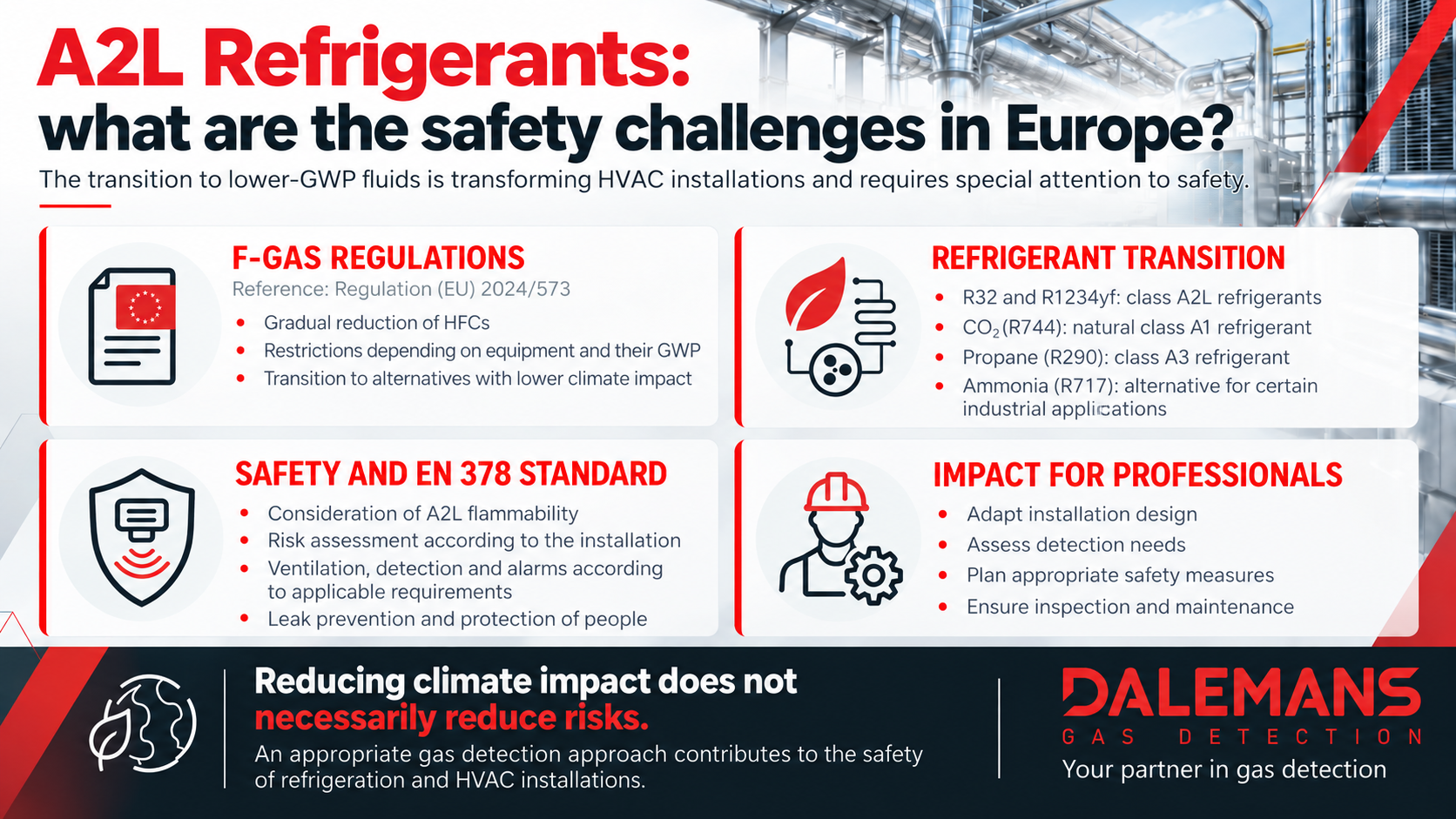
The transition towards refrigerants with a lower climate impact is gradually transforming refrigeration, air conditioning and heat pump installations across Europe. In this context, refrigerants classified as A2L, including R32 and R1234yf, are playing an increasingly important role.
This development is driven in particular by stricter European regulations on fluorinated gases. However, it also requires consideration of the specific safety characteristics of these refrigerants and, where necessary, adaptations to installation design, ventilation, leak monitoring and alarm systems.
For HVAC installers, engineering consultancies, operators and maintenance managers, two references are particularly important: the European F-Gas Regulation (EU) 2024/573 and the EN 378 standard concerning the safety of refrigeration systems and heat pumps.
In brief: what is an A2L refrigerant?
The A2L designation refers to a safety classification for refrigerants. It combines two criteria: toxicity and flammability.
Within this classification:
- A corresponds to the lowest toxicity class;
- 2L refers to refrigerants with limited flammability compared with refrigerants in higher flammability classes.
In other words, an A2L refrigerant is not non-flammable. Its use therefore requires consideration of the risks associated with a leak and the potential accumulation of refrigerant.
The international standard ISO 817:2024 establishes the designation and safety classification system for refrigerants based on toxicity and flammability data. Refrigerant safety classifications should therefore not be confused with their environmental performance.
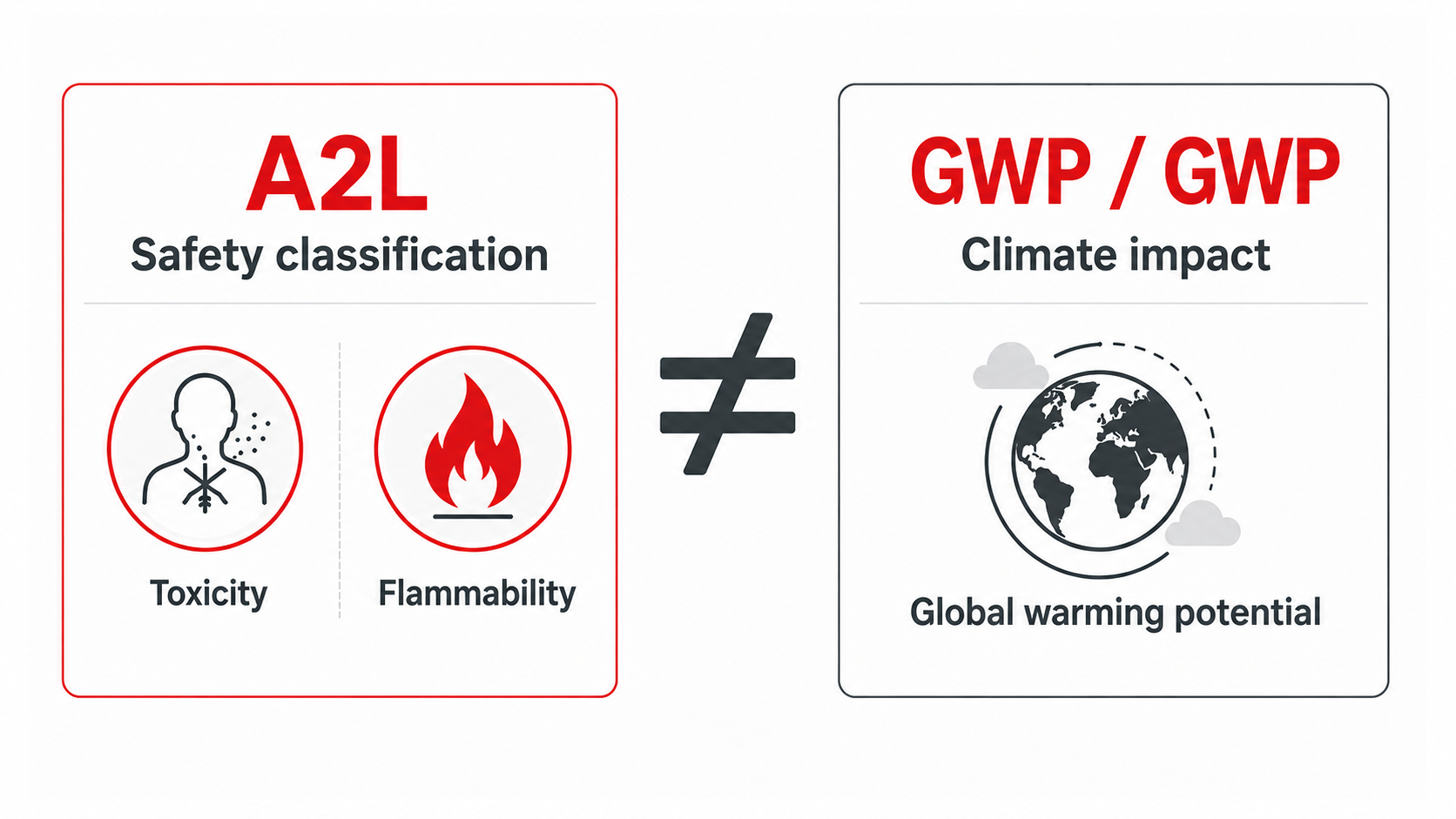
Key takeaway: A2L is a safety classification, not an environmental label. GWP (Global Warming Potential) is a separate indicator.
R32 and R1234yf: examples of A2L refrigerants
R32 and R1234yf are among the A2L refrigerants frequently mentioned in the context of the current transition. Their 2L classification has notably been incorporated into ASHRAE reference work on refrigerant classification.
They clearly illustrate how the market is evolving: reducing the climate impact of equipment does not necessarily mean reducing the risks associated with its use. The properties of the refrigerant must therefore always be taken into account when designing and operating the system.
A2L refrigerants are also just one of several possible solutions. The technological transition also involves natural refrigerants such as CO2 (R744), propane (R290) and ammonia (R717). The choice of refrigerant therefore depends on the application, the desired performance and the installation's safety requirements. The European Commission itself identifies CO2, ammonia, hydrocarbons, air and water among the lower-impact alternatives used in different types of equipment.
Why are lower-GWP refrigerants becoming increasingly important in Europe?
Regulation (EU) 2024/573 on fluorinated greenhouse gases, adopted on 7 February 2024 and applicable since 11 March 2024, has strengthened European policy aimed at reducing fluorinated gases with a high climate impact.
Its main measures include:
- a faster reduction in the quantities of HFCs that may be placed on the European market;
- new restrictions concerning certain types of equipment and specific GWP levels;
- stronger measures to prevent emissions and leaks;
- the gradual phase-out of the HFC quota system by 2050.
Deadlines and thresholds vary depending on the equipment category, including refrigeration systems, chillers, air conditioning units and heat pumps. It is therefore essential to examine the provisions applicable to each project rather than assuming that a single date or threshold applies across the entire market.
These regulatory developments are accelerating the search for solutions compatible with lower-GWP refrigerants. They also explain why refrigeration and HVAC professionals must now consider environmental performance and safety together.
This transition particularly affects air conditioning equipment and heat pumps. To explore this topic further, DALEMANS has also published an article on the impact of refrigerants in heat pumps.
What is the role of the EN 378 standard?
The European EN 378 series of standards (Refrigerating systems and heat pumps – Safety and environmental requirements) is a major technical reference for managing risks associated with refrigeration systems and refrigerants.
It covers four main areas:
EN 378-1: basic requirements, definitions, classification and selection criteria. This part is particularly relevant when determining appropriate installation conditions and refrigerant charges.
EN 378-2: design, construction, testing, marking and documentation of systems.
EN 378-3: requirements relating to the installation site and the protection of people.
EN 378-4: operation, maintenance, repair and recovery of refrigerants.
The amendment to EN 378-3 published in 2020 notably introduced adaptations concerning Class 2L refrigerants, confirming their growing importance in refrigeration system safety.
As standards are regularly updated, the applicable edition and any additional requirements must always be checked during the design phase of a project.
A2L refrigerants: why should leak detection be considered?
When using a refrigerant with a certain degree of flammability, early leak detection can be one of the measures used to reduce risks.
Depending on the installation configuration and applicable requirements, the safety strategy may combine several measures: limiting the refrigerant charge, ventilation, detection, alarms, automatic control functions and measures designed to limit potential ignition sources.
Product standards may also complement EN 378. The IEC 60335-2-40 standard, which applies to various heat pumps, air conditioners and dehumidifiers, takes A2L refrigerants into account. For flammable refrigerant detection systems used in appliances covered by the IEC 60335 series, IEC TS 63542:2024 defines specific requirements.
However, it would be incorrect to conclude that a detector is automatically required in every installation using an A2L refrigerant. The measures to be implemented must be determined according to the type of equipment, the refrigerant, the charge, the installation environment and the applicable standards or regulations.
This is precisely where a technical gas detection assessment becomes particularly valuable.
Discover DALEMANS gas detection solutions for refrigeration applications.
Effective gas detection goes beyond choosing a sensor
A gas detection system must be considered as a whole.
Before selecting a solution, several factors need to be analysed: the refrigerant used, potential leak sources, environmental conditions, the appropriate detection technology, detector positioning, alarm thresholds and any automatic control functions that may be required.
On its website, DALEMANS explains that it carries out technical and regulatory assessments for the integration of gas detection systems, analyses technical specifications, identifies gases and potential leak sources, and helps customers select suitable equipment.
A gas detection control panel can then be connected to various safety devices. For example, depending on its configuration, the DALEMANS U•C2 control panel, designed for refrigerant gas applications, can control ventilation, a siren, a flashing beacon or the shutdown of a refrigeration unit, or transmit a signal to a building management system.
Plan for safety from the design stage rather than making corrections after installation
The transition towards new refrigerants directly affects equipment manufacturers, HVAC installers, refrigeration specialists, engineering consultancies, building operators and technical managers.
For a new project or when replacing existing equipment, it is important to ask the following questions early on:
Which refrigerant will be used? What is its safety classification? How much refrigerant will be present? In what type of room will the equipment be installed? Which standards and requirements apply? Is ventilation or leak detection necessary? Which equipment should be activated or shut down in the event of an alarm? How will the detection system be tested and maintained over time?
This approach makes it possible to integrate safety into a project from the design stage rather than having to modify the installation afterwards.
DALEMANS supports professionals in analysing technical specifications, carrying out technical and standards-related assessments, and defining suitable gas detection solutions for HVAC, refrigeration and industrial applications.
Maintenance remains essential
A gas detection installation is only truly effective if its proper operation is maintained over time.
Maintenance includes checking detectors, their sensitivity, alarm relays and associated control functions. DALEMANS provides maintenance services for gas detection systems used in HVAC applications, laboratories and industrial environments.
A2L, F-Gas and EN 378: three concepts that should not be confused
To summarise:
A2L refers to a refrigerant safety classification based on its toxicity and flammability characteristics.
GWP measures a refrigerant's Global Warming Potential and therefore relates to its climate impact.
The F-Gas Regulation governs the use and placing on the European market of various fluorinated gases and equipment containing them.
The EN 378 standard defines technical safety and environmental requirements applicable to refrigeration systems and heat pumps.
These concepts complement one another. As refrigerants evolve, the objective is not simply to reduce GWP: equipment must also be designed, installed, monitored and maintained with due consideration for the properties of the refrigerant used.
For DALEMANS, a European specialist in gas detection, this development confirms the importance of integrating gas detection and risk management at an early stage of a project's technical planning.
FAQ – A2L Refrigerants, EN 378 and Gas Detection
An A2L refrigerant belongs to a safety classification defined according to toxicity and flammability. The letter A corresponds to a lower toxicity class, while 2L designates a class of flammable refrigerants with a limited flame propagation speed. This classification is defined in the ISO 817 standard.
Yes. R32 and R1234yf are classified as A2L refrigerants. R32 is commonly used in air conditioning and heat pump applications, while R1234yf is notably used in automotive air conditioning. Their A2L classification relates to safety and should not be confused with their GWP, which measures their potential contribution to global warming.
The European F-Gas Regulation (EU) 2024/573 accelerates the reduction of HFCs placed on the European market and provides for the gradual phase-out of the quota system by 2050. This development encourages the adoption of solutions with a lower climate impact, including certain A2L refrigerants and natural refrigerants.
The EN 378 series establishes safety and environmental requirements for refrigeration systems and heat pumps. Part 3 specifically addresses installation sites and the protection of people. The EN 378-3:2016+A1:2020 amendment explicitly incorporated requirements relating to Class 2L refrigerants.
The mere presence of an A2L refrigerant does not mean that a detector is always mandatory. Safety measures depend on factors such as the equipment, the installation and the applicable standards. For certain applications, technical standards include refrigerant detection systems among the measures that can be used to manage the risks associated with flammable refrigerants.